
To understand why the market for pet food and pet packaging in Latin America remains surprisingly stable despite economic crises, one must look to Argentina. Hardly any other country combines such a pronounced pet culture with recurring economic upheavals. The result is a market full of contradictions—and that is precisely where its dynamism lies.
Even a cursory look at the prevalence of pets reveals the special place animals hold in the daily lives of many Argentines. According to estimates, approximately 80 to 82 percent of all households have at least one pet. This figure remains remarkably stable across various studies, even if the exact data sources are not always transparent. Even conservative estimates are only slightly lower.

This places Argentina among the global leaders. Here, pets are less a possession and more a part of the family—a finding that has implications not only culturally but also economically.
Dominance of Dogs, Quiet Rise of Cats
Within the pet population, a clear picture emerges: dogs dominate. Depending on the source, between 78 and 85 percent of pet owners have at least one dog. Cats lag significantly behind, with figures ranging from about 30 to over 50 percent—an unusually wide range attributable to different survey methods.
A key difference: Some studies measure the proportion of all households, while others measure only among pet owners. This creates apparent contradictions, which, upon closer examination, can be explained.

Despite these uncertainties, the trend is clear: While dogs have historically dominated, cats are gaining increasing prominence—especially in urban areas. Reasons for this include lower space requirements, lower ongoing costs, and changing lifestyles in cities.
A large market – despite economic uncertainty
With over 30 million pets among a population of around 45 million, Argentina is a significant market not only emotionally but also in terms of volume. Sales in the pet food sector are estimated at approximately $1.4 to $1.7 billion for the year 2025.
The range results from differing market definitions: While some analyses consider only traditional retail, others also include informal distribution channels or specialty segments. The actual market size is therefore likely to fall within this range rather than at a precise point.

The growth is particularly noteworthy. Despite high inflation and recurring economic crises, the market is growing by about seven to eight percent annually. An apparent contradiction that resolves itself upon closer examination.
Quality or price? Both.
Argentine pet owners exhibit nuanced consumer behavior. On the one hand, around 85 percent state that they pay particular attention to quality when purchasing pet food. On the other hand, price plays a central role for about two-thirds of consumers.
This combination of quality consciousness and price sensitivity is typical of markets under economic pressure. It leads to strong segmentation: While some consumers consciously invest in premium products, a large portion remains in the price-driven segment.
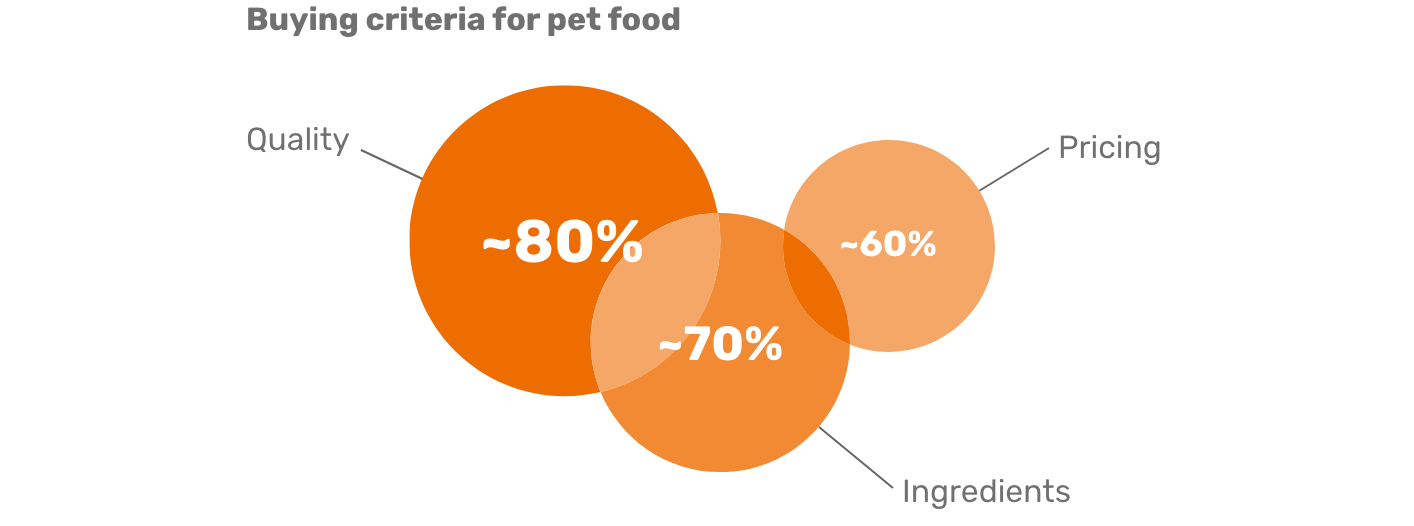
Also striking is the role of veterinarians as a source of information. Around 70 percent of consumers rely on their recommendations—a comparatively high figure that indicates a strong trust in professional advice.
A Market Caught Between Two Forces
The true uniqueness of the Argentine market, however, lies not in individual metrics, but in their combination. An extremely high pet ownership rate collides with an economically fragile reality. Pet owners view their animals as family members—but at the same time must manage with limited financial resources.
For providers of pet food and packaging solutions, this presents a clear challenge: products must appeal emotionally while remaining economically accessible.
Argentina, Brazil, and Mexico in Comparison
A look beyond national borders reveals that Argentina plays a unique role within Latin America—though it cannot be viewed in isolation.
Brazil: The Giant
Brazil is the region’s largest market and ranks among the world’s leading countries in the pet food sector. Estimates indicate:
• Pet population: over 160 million
• Pet food market size: approx. 8–9 billion USD
• Households with pets: ~60–70%
Mexico: A Growing Market Undergoing Structural Change
Mexico presents a different profile:
• Pet population: ~80 million
• Pet food market size: ~3–4 billion USD
• Households with pets: ~70–75%

Argentina is no ordinary market. It is a country where pets hold exceptionally high emotional significance—and that is precisely why the market remains stable even under difficult economic conditions.
Compared to Brazil and Mexico, it lacks sheer size. Yet it is precisely this smaller but more intense relationship between humans and animals that makes Argentina a particularly interesting market.
In other words: While Brazil impresses with volume and Mexico with growth, Argentina is one thing above all else—a market with exceptional loyalty.
Imports and Exports

Argentina is largely self-sufficient in pet food production. Imports play a negligible role, accounting for an estimated share of less than one percent, while exports are primarily destined for regional markets such as Chile or Peru. Exact trade volumes are difficult to determine, as available data is mostly based on individual shipments and does not provide complete market transparency.




.png)